Saturday, April 26, 2014

The Maze Runner Trilogy By James Dashner

MazeRunner

The Maze Runner is a read in an entire day sort of book. It’s fast paced and never lets up. The continual questions kept me glued to the pages. What is going on here? My imagination ran wild with the possibilities and I was afraid that in the end I’d be disappointed, but surprisingly I wasn’t. The conclusion actually made sense and didn’t seem contrived just to explain the author’s cool concept.

I would have liked more character development, so that I could get to know the characters better and care about what happens to them more. (Though this is the sort of book I don’t dare get attached to anyone going in.) I understand that it must have been hard for the writer to show characterization when none of the characters has a past. Yep, that’s right none of the characters can remember anything before the maze.

Thomas wakes up in an elevator box with no memory other than his name. He’s greeted by other teenage boys in an area called the glade. The glade is surrounded by a massive maze that the boys are trying to solve to escape. Surprisingly for a group of kids they’ve established an organized society where everything works. I can’t really say anything more about the premise without spoiling things. The whole point of the book is to keep reading to figure out the why behind the maze.

The Maze Runner is a quick book. There are no slow spots with flowery descriptions here. Other than height, age, and shoe size all we know about the main character’s appearance is he has brown hair. I like a bit more than that, but that’s not the sort of book this is. Maze Runner's also light on romance, which is odd for a young adult book, but it worked. There wasn’t time for romance. (Though there is more romance in the Scorch Trials.)

The Maze Runner is almost an eight star book, but fell just short of great for me. I can’t explain without minor spoilers, so skip the rest of this paragraph if you don’t want spoilers of any sort. (It’s not really a spoiler that characters die in a book like this, but I know how some people are about spoilers of any kind.) I have no problem with characters dying, but I didn’t like the way a certain character died. It didn’t feel necessary and it was too brutal for me. (Though it was tame compared to a death in the Death Cure. I just know I’m going to have nightmares about that.)

The rest of the trilogy (spoiler free) I haven’t been so disappointed in an author in a long time. These books had such potential! Most of the story is good, but the Scorch Trials and The Death Cure had some serious flaws. (In my opinion) They were too gruesome, (scary doesn’t have to be gross) there was too much pointless action, (it got a bit much after a while) certain parts made no sense, (and I didn’t like them) and the main character kept acting stupid. (After the Maze Runner I expected more out of him, he is supposed to be a genius after all.)

So my recommendation is you should read the Maze Runner, it’s a good, unique book, but skip the the Scorch Trials and The Death Cure. (Though I doubt I’d be able to follow my own advice. I just have a need to find out what happens.)

The Maze Runner: 7/10 Stars

The Scorch Trials: 5/10 Stars

The Death Cure: 4/10 Stars

What is your opinion on character’s deaths, should they come quick and unexpected or do you like to see it coming?

I like to be prepared before a character dies, (I’ve been known to peek ahead...) but I don’t mind deaths as long as they serve a point for the story.

Next week's review: The Lunar Chronicles series by Marissa Meyer. Cinder, Scarlet, & Cress.

Saturday, April 19, 2014

Book Review ~ Angelbound By Christina Bauer

angelbound

Sorry for not posting last week. We had some major storms here in Michigan and I didn’t have power for a few days. The good news is with not much else to do I read the entire Maze Runner Trilogy. I’ve saved that review for next week though, because I read a better (and less known) book on Thursday.

I don’t know what it is about me and tail fascination. I’ve just always wanted one. So naturally the reason Angelbound caught my eye is the main character has a tail. (The author actually uses her tail to show emotion and humor too.)

Angelbound is told in a fun voice with plenty of humor and I liked the strong sassy heroine, Myla. It might just be me, (because I couldn’t pry the book out of my fingers to go to bed.) but this book was a quick read. I think Angelbound will appeal to fans of the Mortal Instruments.

Myla is a quasi demon (meaning part human) living in purgatory. Around twenty years ago demons invaded purgatory and left ghouls running things. Myla’s mom is super over-protective and won’t say anything about her life before the war with the demons or even about Myla’s father.

Myla spends most of her time at school, but every so often she’s called to duty. When a soul enters purgatory they can choose trial by combat. Since she was twelve Myla’s been required to fight to the death in the arena against theses souls. As the best fighter they save the nastiest ones for her, but she’s not your typical almost eighteen year-old. She enjoys her battles in the arena, particularly when it’s against a demon and she keeps extensive notebooks on how to beat the various demon races.

Myla’s best friend Cissy (who has the tail of a golden retriever, yes it does wag when she’s happy. Okay, enough about tails...) has a huge crush on a boy at school, so when said boy invites Myla and a guest to his party she can’t say no. At the party, abandoned by her friend, Myla meets the frustrating prince Lincoln. He’s a demon hunter who thinks all quasis are evil, but Myla can’t stop thinking about him and not just about punching him. Well, that too.

Romance is a strong part of this book and it’s well done. (I only wish we’d gotten to see all of their conversation in the maze instead of hearing about it afterwards...) There’s really only one make-out session that makes this an older YA book, but other than that it’s pretty light.

Angelbound has interesting characters and good world building. The plot is a bit predictable, but that isn’t always a bad thing. There are a few slow spots towards the beginning, but I’m glad I kept reading, because it quickly picks up. I did notice several errors, but I’m very nit picky about that sort of thing and often find such in books.

I give Angelbound 7/10 stars and would definitely recommend this book. (I can’t wait until the sequel comes out next month!) Buy it on Amazon and Barnes and Noble.

Have you read any good books lately?

Saturday, March 29, 2014

How to fix a bumpy story and make it flow

bumpystoryflow

My second chapter was terrible! I wanted to show time passing, and cover a few events along the way, but it wound up a bunch of disjointed scenes jumping for one place to the next. It's a balancing act, showing enough for world building, but without boring readers with unnecessary travel. (Unfortunately I’m a klutz and that’s how this chapter came off, clumsy.)

After working on it for a week (yes, an entire week for one 5000 word chapter) I've ironed it out quite a bit. It now reads more like a chapter instead of a bunch of scenes haphazardly stuck together.

Here’s how I did it.

~CUT SCENES~

First cut out any scenes that aren't necessary. I keep asking myself, okay I like this scene, but how important is it? I keep everything I cut just in case, but some things have to go.

~REARRANGE & COMBINE~

The next step is rearranging and combining scenes. Which scenes can be changed to go together? If I move this scene from down here, I can add it to this one up here, and ta-da no more jumpy scenes, but one longer one.

~SMOOTH TRANSITIONS~

Finally smoothing out the last of the bumps and making sure the transitions are clear. When there a change in time, location, or character it has to be obvious to the readers.

I added parts to make it continuous instead of lots of little scenes and some lines of narration could be told by the characters instead. (Wallah! (not sure how to spell that) Instant showing instead of telling.)

I have to keep telling myself, ‘this story isn't set in stone, I can change it.’ Just because I wrote it this way the first time doesn't mean that’s the best way to tell my story.

Curious what I did? Click on the image above for an example. :) (Note: I’m still not happy with this chapter, but it’s certainly better than it was.)

What do you think the best method is for showing time passing?

Saturday, March 22, 2014

How to find out how many words made the cut

I've done so much editing and rewriting I wanted to know how many words from my rough draft made the cut.

Open Microsoft word, you don't have to open a document.

MicrosoftWordCompare

1. Go to the review tab.

2. Click on compare and select whether you want to merge the documents or just compare them. Select Merge.

3. Under original document choose the rough draft and then under revised select the edited version. (There are options on what you want to compare, but I only compared adds, deletions, and moves.) Make sure your rough draft has a different font!

4. Open the merged document, it should have red font all over it. Under Review, track changes click the bottom for change tracking options and it pulls open a window. Change deletions to #.

changes

5. Click on the black font in the document, (the part that didn't change) and click the home tab, on the right side there are selection options.  Select text with similar formatting.

select

Now the hard part, wait. On my old Acer computer this step took 10-15 minutes and it locked up if I tried to do anything. (Oh, how I wish I had patience.)

6. Copy the font, ctrl+c (Don't cut, that made it lock up for me too.) and past it into a new document.

7. Ta-da! Now you have the words that made it from the rough draft to the final!

How many did you have? I only had 38,000 words out of 108,000!

Saturday, March 15, 2014

Woven Magic ~ Writing Update

wmwordleIt’s amazing how different my book is from when it started. Out of 108,000 words only 38,000 words are still the same as my rough draft! (That's a lot of rewriting!)

I saved every version of my book, including my rough draft. It was worth it, not just to compare them, but because it's hilarious reading it now. They say rough drafts are meant to be crap, yup mine was.

I still have a three page to-do list, but (I think) I'm finally done with major rewrites. (I like to-do lists, it makes me feel like I've really accomplished something when I get to check it off.)

From what I've read it takes everyone a different length of time to write their first novel, from a few months to a few years. My goal was to get mine done in a year, but that's not going to happen. (Since that would be next month.) So, I’m shooting for the date I finished writing, the end of July. I want it to be as good as I can make it, but I know I have to eventually stop editing.

How long did it take you to write and edit your first novel?

Saturday, March 8, 2014

Writing Internal Conflict

Internalconflict

(Yes, I made this beautiful picture myself.)


Something was missing from my book, but I couldn't figure out what. After reading my story for the umpteenth time, I realized my mistake. I forgot to show the internal struggle going on inside her head. A character can be complex and likable, but if the readers aren't inside her head, they’ll feel like the book is lacking something. (Which is what I was feeling.) I had to go through my entire story again and rewrite a lot of her internal dialogue. (Just what I needed, another rewrite...)

I know things are going to go wrong for my main character, so I started her out happy. That isn't realistic though, everyone is unhappy about something. It’s important to show what makes the main character unhappy in the beginning of the book, whether it’s loneliness, feeling stuck in responsibilities, or whatever.

I wanted my heroes to come off as brave, but I realized that doesn't mean they shouldn't have any fears or worries. Overcoming your fears is braver than not having any, that’s just stupidity. (Which is how my character was coming off...) So I had her put on a brave face, but added her worrying if she'd made the right choice. 'I could die. What have I gotten myself into?’ This also raises the stakes when the character realizes how dangerous things are.

My main character had changed after all of her experiences, which is why I was having trouble with a scene towards the end. I still had her acting like the character she was at the beginning. I had to realize that something that would be out of character for her at the start would totally be something she'd do after a year with my other main character. (He’s a bit of a bad influence.)

What does your character unhappy about? Do you fix it for them or just give them more problems?

My character is lonely and wants to have friends and fit in. I don’t make it easy for her, (my poor little characters.) but I do give her a couple of friends. She’s a stronger person than when she started her journey, but she doesn't fully accept herself yet. (She is only twelve.)

Saturday, February 22, 2014

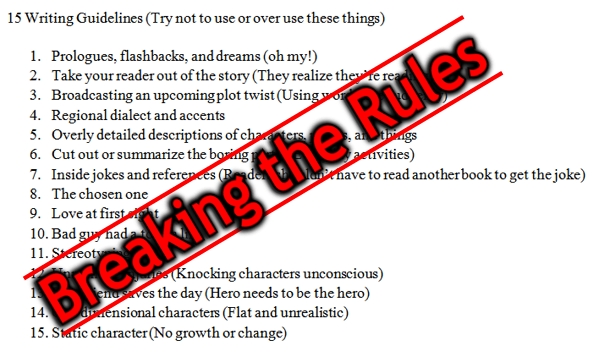
Breaking the rules of writing

breakingrules

For every rule, there is a reason to break it. Granted, breaking the rules takes more work, because the writer has to do everything right. Here are times where famous authors broke the rules and why it worked for them.

(Sure glad I wrote this ahead of time for once. I spent the last two days without a computer, because it decided to throw a tantrum. I barely survived!)

Don’t have a Prologue

JK Rowling starts with a prologue, even if it’s called chapter one. It works because it's the hook. Can you imagine Harry Potter without chapter one? The reader wouldn't know anything about the magical world, or that Harry is special. It would just start with Harry’s miserable life with his Aunt and Uncle. We keep reading, because we want to find out how Harry’s life will change, because we know it will.

 Don’t describe your character in a mirror

Veronica Roth described her character in a mirror in Divergent, but it worked for her because of why she did it. Beatrice has rarely seen herself in a mirror, so she would be interested in what she looks like. It also shows what the world is like and is an opportunity to show character growth the next time Beatrice sees her reflection. (I’m trying not to spoil the story.)

Don’t use flashbacks

Suzanne Collins uses flashbacks effectively in the Hunger Games. This is because the reader always knows when we’re in a flashback and it’s something the character is thinking about. She doesn't tell us about what happened, but takes us back to the scene and shows us. The flashbacks are important to the story to show how the characters met. Her story wouldn't be nearly as powerful if we didn't feel what it was like for Katniss in the past.

Don’t break the fourth wall (make your characters know the reader is reading a book)

Rick Riordan does this in Percy Jackson. It’s his way of showing voice and introducing comedy. It doesn't take you out of the story and is easily ignorable, because he doesn't do it often. It also lets him just say, “I’m Percy Jackson, 12 year old half-blood”. (Well not exactly, but close enough.)

I debated mentioning how Stephenie Meyer uses verbs other than said and adverbs to modify said, but since I've never read Twilight, (too much romance for me) I don't know why it worked for her.

Some authors get away with things others can’t pull off. They are rules for a reason, so before breaking them, ask yourself why you’re breaking the rules.

I’m on a young adult reading kick, hence the examples. ;)

Do you break any of the rules?

I’m on the verge of breaking a few. At the beginning, my character gets knocked out a couple of times, but it’s for story development, (overuse of magic) not to transport her someplace different mysteriously.